KiKIT: Foundational Research in Helmholtz
The SEEALL group is funded by KiKIT, a pilot project in the Helmholtz Association which is centered around basic and foundational computer science research.
 Research
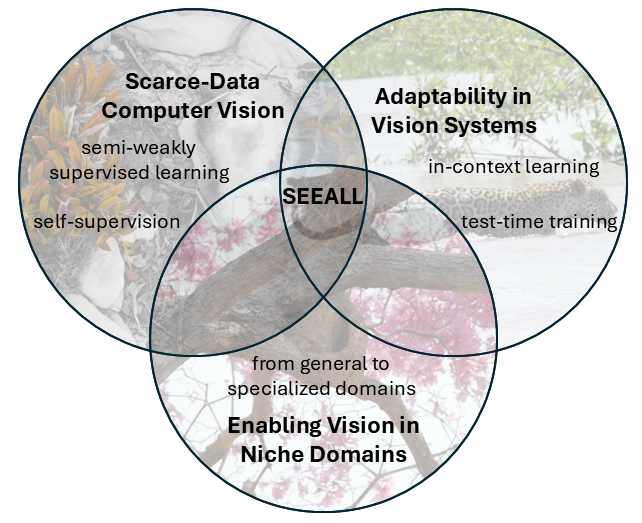
Human intelligence thrives on context, yet most vision models are trained in context-free or only superficially contextual ways. Our research bridges this gap by developing highly contextual computer vision systems: models that learn and adapt dynamically, mirroring the flexibility of human perception.
We focus on three core challenges:
Modern vision models rely on vast, expertly labeled datasets, which are often unavailable in specialized fields like medical or scientific imaging. We pioneer learning paradigms—such as semi-, weakly-, and self-supervised learning—to enable robust visual understanding with minimal annotation effort, making advanced vision systems viable even in data-scarce environments.
Real-world applications demand flexibility, yet most models are rigid, requiring costly retraining for new tasks or conditions. Our work centers on visual in-context learning and efficient test-time adaptation, enabling models to generalize on-the-fly to distribution shifts, novel tasks, and evolving user needs—without full retraining.
Specialized domains, from medical imaging to scientific research, need tailored vision solutions. We develop generalist models that adapt dynamically to unique, one-of-a-kind problems through visual in-context learning and lightweight customization. This approach democratizes visual intelligence, allowing niche applications to flourish with minimal resources.
At the SEEALL group, we believe vision systems should be as dynamic as the world they perceive. By advancing sample-efficient, compute-efficient, and user-friendly learning paradigms, we aim to make visual intelligence accessible to everyone, regardless of their expertise in computer vision or their resources. Our goal is to empower users to build vision solutions effortlessly, unlocking meaningful insights in ever-changing environments, we aim to develop the generic methods and models to enable this.
The SEEALL group is funded by KiKIT, a pilot project in the Helmholtz Association which is centered around basic and foundational computer science research.